
 Tiếng Việt
 Home
Home Introduction
 Announcements
 Student Essential
 Event attendance lists
The invention by the research team of the Institute of High Technology, Nguyen Tat Thanh University, has been granted an exclusive patent by the Intellectual Property Office under Decision No. 13423/QĐ-SHTT dated March 27, 2023, opening a new direction for applying UVC-LED technology combined with a quartz vibrating screen to treat microorganisms on the surface of agricultural products without using chemicals, heat, or ionizing radiation.
The research team includes: Assoc. Prof. Tran Viet Cuong, PhD; Nguyen Hoang Hung, PhD; Huynh Tran My Hoa, PhD; Pham Hoai Phuong, MSc; Le Tien Dung, PhD; Vu Van Van, PhD; Ngo Nguyen Vu, MSc; and Dinh Duc Anh, PhD. They developed the invention titled “Sterilization device for post-harvest or post-processing agricultural products,” stemming from the practical needs of businesses processing and distributing clean agricultural products.
From the practical problem of agricultural processing plants
In the agricultural value chain, the post-harvest and post-processing stages are always “sensitive points” that determine product quality before reaching the market. For vegetables, dried fruits, packaged agricultural products, or products for export, the issue is not only making delicious, beautiful, and uniform products but also controlling microorganisms, ensuring food safety, and maintaining the natural quality of the raw materials.
Traditional sterilization methods such as heat treatment, chemical treatment, irradiation, or microbial inhibition technologies all play a certain role in production. However, each method has its own limitations. Heat treatment can change the surface structure, freshness, flavor, or some sensory characteristics of the product. Chemical treatment, if the process, dosage, and time are not strictly controlled, can leave unwanted residues in agricultural products. Meanwhile, many processing businesses today need cleaner, less intrusive treatment solutions that are more suitable for the increasingly high requirements of the market.
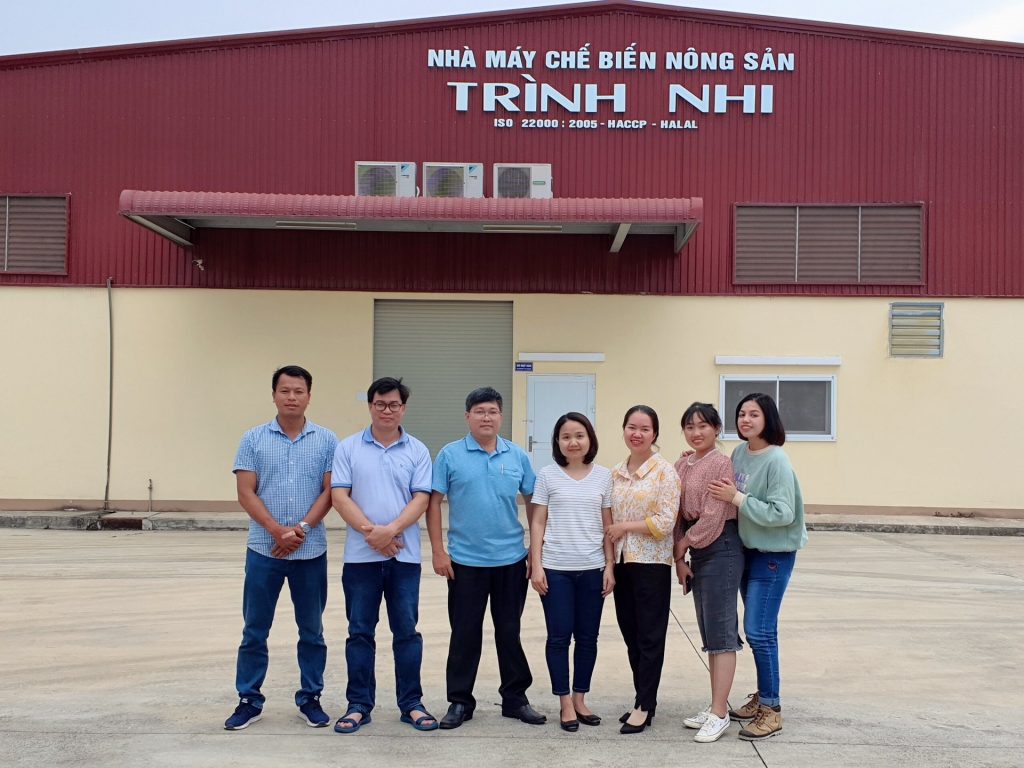
The research team at Trinh Nhi Agricultural Processing Factory (Lam Dong)
The invention idea of the NTTU research team stems from this very need. The initial problem came from the need to preserve post-harvest agricultural products and process them before manufacturing, including a practical proposal from Trinh Nhi Agricultural Processing Factory under Trinh Nhi Agricultural Products Company (TNFoods) in Lam Dong. Businesses need a device capable of supporting sterilization for agricultural products but minimizing the impact on product quality. From that requirement, the research team set a clear goal: to develop a microbial treatment device without using chemicals or heat, while limiting the risk of degrading agricultural product quality after processing.
UVC-LEDs and quartz vibrating screen: the novelty of the invention
The core value of the invention lies in combining UVC LED lights with a quartz vibrating screen. In principle, UVC rays are a physical agent capable of acting on microorganisms on the surface. Unlike chemical methods, UVC does not add chemical agents to the product. Unlike heat treatment, UVC does not heat agricultural products in the way traditional thermal technologies often cause. Thanks to this, if designed and operated appropriately, this technology can support the treatment of product surfaces while still aiming to maintain the flavor, freshness, water content, salt, and minerals in the tissue and cell layers of agricultural products.
However, treatment with UVC rays also has a major technical challenge: UV rays have low penetration capability, mainly acting on the surface. If only shone from one direction, shaded areas or parts of agricultural products in direct contact with the floor may not be treated evenly. For agricultural products with irregular shapes, rough surfaces, or different sizes, this challenge is even clearer.
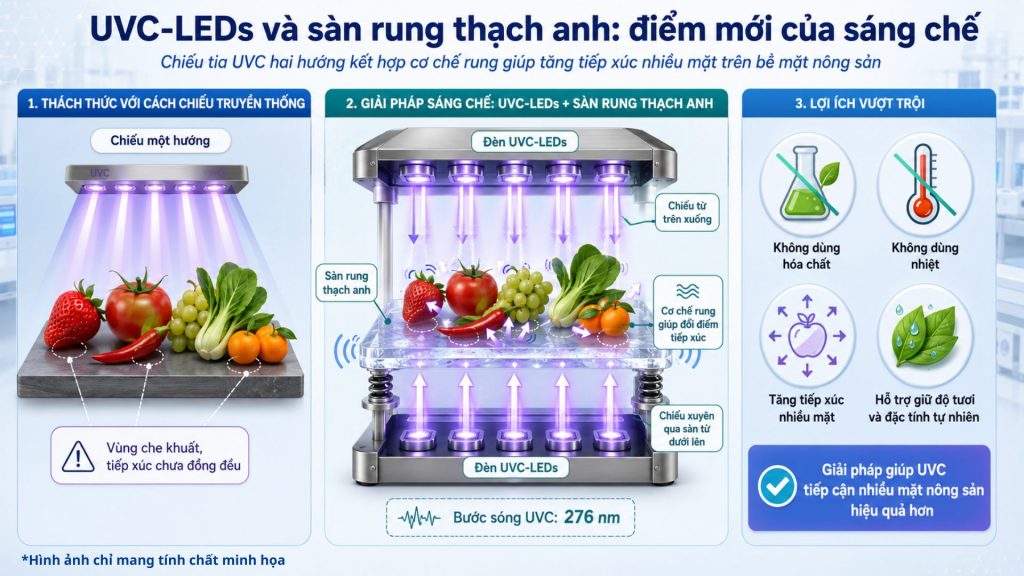
This is exactly the point where the NTTU research team provides a solution. Instead of designing a conventional UVC lighting device, the invention uses a vibrating screen made of quartz. Quartz material allows UVC rays to pass through, so the device can shine rays in two directions: from above to contact the product surface directly and from below through the quartz screen to affect the part of the agricultural product lying on the screen. When combined with vibrating movement, the product is moved slightly, changing the contact point and increasing the accessibility of UVC rays to many different sides.
Therefore, the invention not only places UVC lights in the agricultural processing line but solves a very specific bottleneck of beam-casting technology: how to get UVC rays to contact more sides of the product. It is the combination of UVC-LEDs source, quartz screen for ray transmission, and the vibration mechanism that creates the distinct technical structure of the device.
According to the research team’s description, the device uses UVC rays in the 276 nm wavelength region. This is an important technical parameter, associated with the orientation of using UVC as a physical agent in treating the surface of agricultural products. With this design, the invention aims to sterilize more effectively on the product surface while limiting the use of agents that can generate chemical residues or affect the natural characteristics of agricultural products.
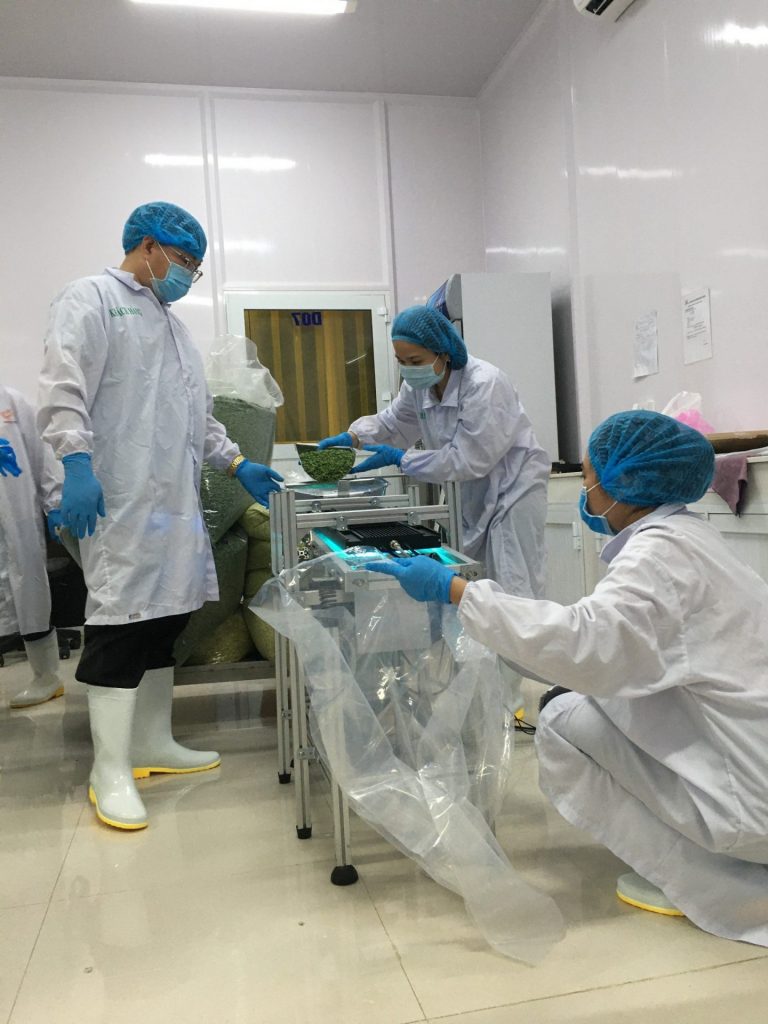
Operating the invention device at the testing lab of Trinh Nhi Agricultural Processing Factory
Why choose UVC-LEDs instead of mercury vapor lamps?
Another notable point of the invention is the orientation to use LED technology emitting UVC rays. In many traditional UV devices, the light source is often mercury vapor lamps. This type of lamp has been widely used but also has some limitations such as low longevity, higher power consumption, and requirements for safe handling when there is a risk of mercury leakage or when the device reaches the end of its life cycle.
Meanwhile, UVC-LED technology is attracting attention in many surface, environmental, and sterilization applications thanks to its flexible design, compact size, ability to be arranged in modules, and suitability for the trend of reducing environmental risks in industrial equipment. For the agricultural processing industry, factors such as durability, operational safety, integration capability into production lines, and long-term usage costs are no less important than treatment efficiency.
The research team’s choice of UVC-LEDs shows that the invention not only solves the immediate sterilization problem but also aims for a device capable of developing according to the factory’s needs. Depending on the production scale, type of agricultural product, and processing requirements, the system can be continuously optimized regarding the number of lights, exposure time, intensity, vibration speed, floor area, and layout in the line.
Application potential in clean agricultural processing
Direct beneficiaries of the invention are agricultural processing units, especially facilities producing dried vegetables, post-processing fruits, packaged agricultural products, or products needing surface treatment before storage and distribution. With these product groups, a chemical-free, heat-free treatment technology can contribute to protecting sensory quality and reducing pressure on controlling residues in the final product.
For businesses, the device opens up an additional technology choice in controlling microorganisms on the surface of agricultural products. For consumers, the solution aims for safer products, limiting chemical residues, and retaining the natural characteristics of raw materials. For the agricultural processing industry, this is a direction consistent with the trend of increasing post-harvest value, developing deep processing, and meeting the more rigorous requirements of the market.
Applied research imprint of NTTU
From the practical needs of Trinh Nhi Agricultural Products Company (TNFoods) in Lam Dong, the Nguyen Tat Thanh University research team developed the UVC-LEDs vibrating screen system invention as a technological solution serving directly for the clean agricultural product processing problem. With a business currently operating an agricultural processing factory with a scale of 12,000m², cooperating with cooperatives and over 100 farming households in Da Lat, Duc Trong, Don Duong, while aiming for a green, clean, and sustainable supply chain, the requirement for controlling microorganisms post-harvest or post-processing is not only a technical issue but also a condition to ensure quality, food safety, and the ability to expand the market.
In that context, NTTU’s invention becomes an important link in the modern processing approach, using physical agents to treat the surface of agricultural products, reducing dependence on chemicals, limiting thermal impacts, and contributing to maintaining the product’s natural quality. From a specific proposal by the business, the research team transformed the production problem into a technical solution, tested the device in the lab and factory environment, and established intellectual property rights for the technology. This is a clear testament to the role of Nguyen Tat Thanh University in research, developing inventions serving life, accompanying businesses, and contributing to increasing the value of Vietnamese agricultural products.
With a focus on strengthening technology transfer from university to business, the research team is ready to coordinate professional exchange, testing, and connection for device transfer with businesses, cooperatives, and agricultural processing units in need of applying post-harvest treatment technology. Interested units can contact Huynh Tran My Hoa, PhD, Institute of High Technology, Nguyen Tat Thanh University (Email: htmhoa@ntt.edu.vn) to discuss more about the potential for research and application cooperation.
Ho Quy